“Being Human” Stops Being an Advantage
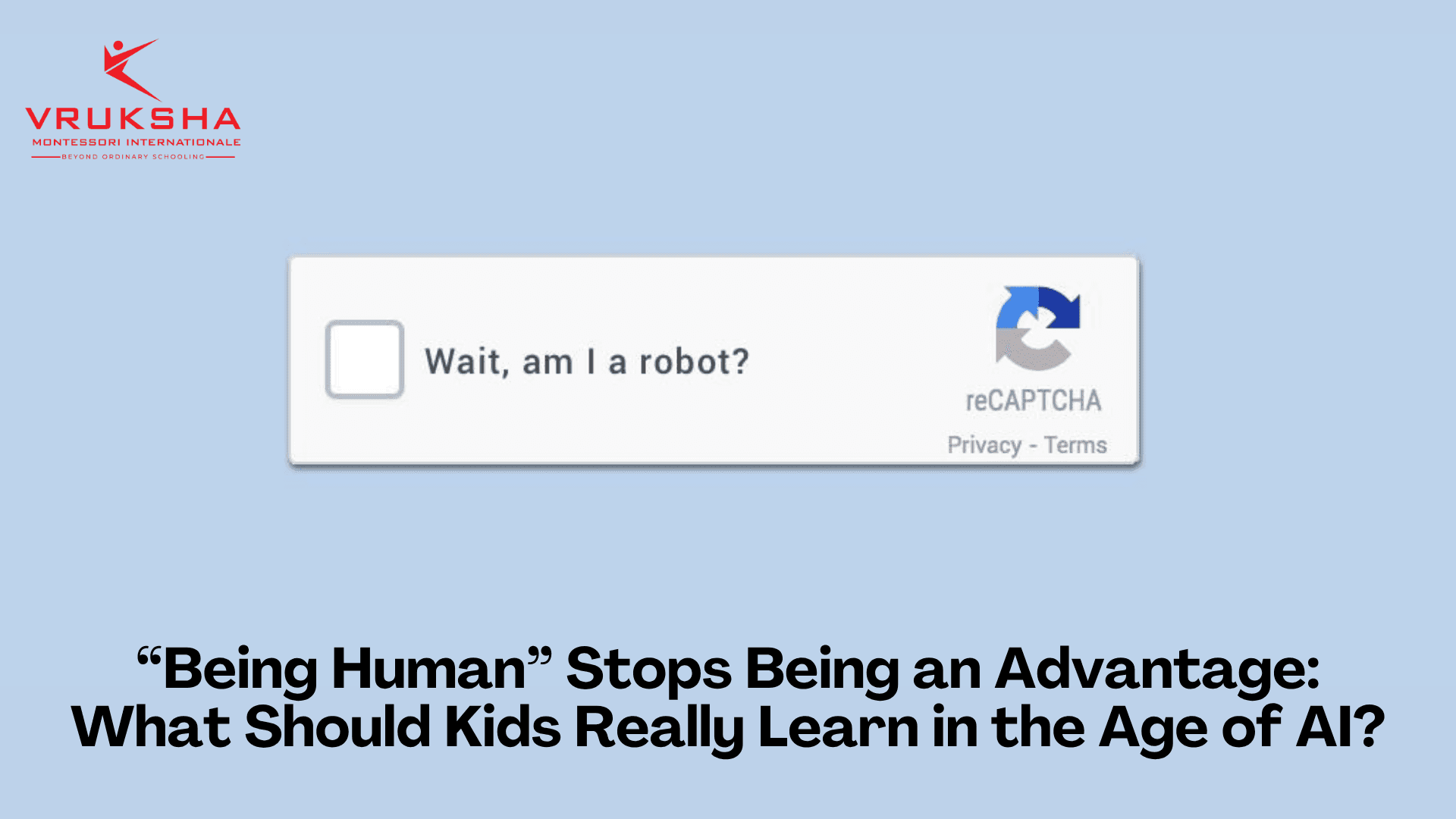
Recently, an AI developed by OpenAI reportedly passed a “I am not a robot” test not by hacking the system but by behaving like a human. This moment isn’t just a technological milestone; it’s a wake-up call.
For decades, being human, thinking, responding, and solving were our biggest advantages. But what happens when machines can do all that too?
Now the real question for parents and educators is the following:
What should children learn today to stay relevant tomorrow?
The Shift We Can’t Ignore
Traditional education systems still focus heavily on:
Memorisation
Repetition
Predictable, structured answers
These were once essential skills. But today, AI tools like ChatGPT can:
Recall vast amounts of information instantly
Generate structured answers in seconds
Learn patterns faster than humans
In short, the very skills schools reward are the ones AI is rapidly mastering and outperforming.
The Outdated Belief: “Good Marks = Safe Future”
Many parents still believe that high academic scores guarantee success. While marks do reflect effort and discipline, they no longer define future readiness.
Why?
Because the world has changed.
Information is no longer scarce
Answers are no longer hard to find
Execution is becoming automated
So what truly matters now isn’t what your child knows but how your child thinks.
The Real Divide: Thinkers vs Repeaters
The gap today isn’t between
Good schools vs average schools
It’s between:
Children trained to repeat information
Children trained to think independently
Children who only repeat:
Depend on instructions
Struggle with uncertainty
Compete directly with AI
Children who think:
Ask questions
Solve new problems
Use AI as a tool, not a threat
This is the new divide, and it’s growing fast.
Skills That Will Matter in the Next 10 Years
To stay ahead in an AI-driven world, children need to develop:
1. Critical Thinking
The ability to analyze, question, and evaluate information instead of accepting it blindly.
2. Creativity
AI can generate ideas, but original thinking still comes from human imagination.
3. Decision-Making
Choosing the right path in uncertain situations is a deeply human skill.
4. Emotional Intelligence
Understanding people, empathy, and communication are areas where humans still lead.
5. Adaptability
The future is unpredictable. The ability to learn, unlearn, and relearn will be crucial.
Why Early Development Matters
Here’s the hard truth:
These skills are not built overnight.
A child trained only to memorise in early years
Will not suddenly become a critical thinker later
Thinking, questioning, and reasoning are like muscles; they need to be trained consistently from a young age.
By the time the importance of these skills becomes obvious to everyone, the gap between children will already be too wide.
What Parents Should Do Now
You don’t need to panic, but you do need to shift perspective.
Encourage curiosity
Let your child ask “why” instead of just memorizing "what."
Focus on understanding, not marks
Marks are temporary. Thinking skills are lifelong.
Introduce problem-solving activities
Games, puzzles, and real-life scenarios build decision-making.
Allow mistakes
Failure is where real learning happens.
Teach them to use AI wisely
Instead of avoiding AI, help children learn how to use it as a tool.
The Biggest Risk Isn’t AI
AI is not the threat.
The real risk is assuming that the current education system alone will prepare your child for the future.
Because it won’t.
Conclusion
We are entering a world where “being human” is no longer enough
Thinking like a human is what will truly matter.
The children who succeed won’t be the ones who memorized the most.
They’ll be the ones who learned how to think, adapt, and grow.
The future doesn’t belong to those who compete with AI.
It belongs to those who know how to work with it.