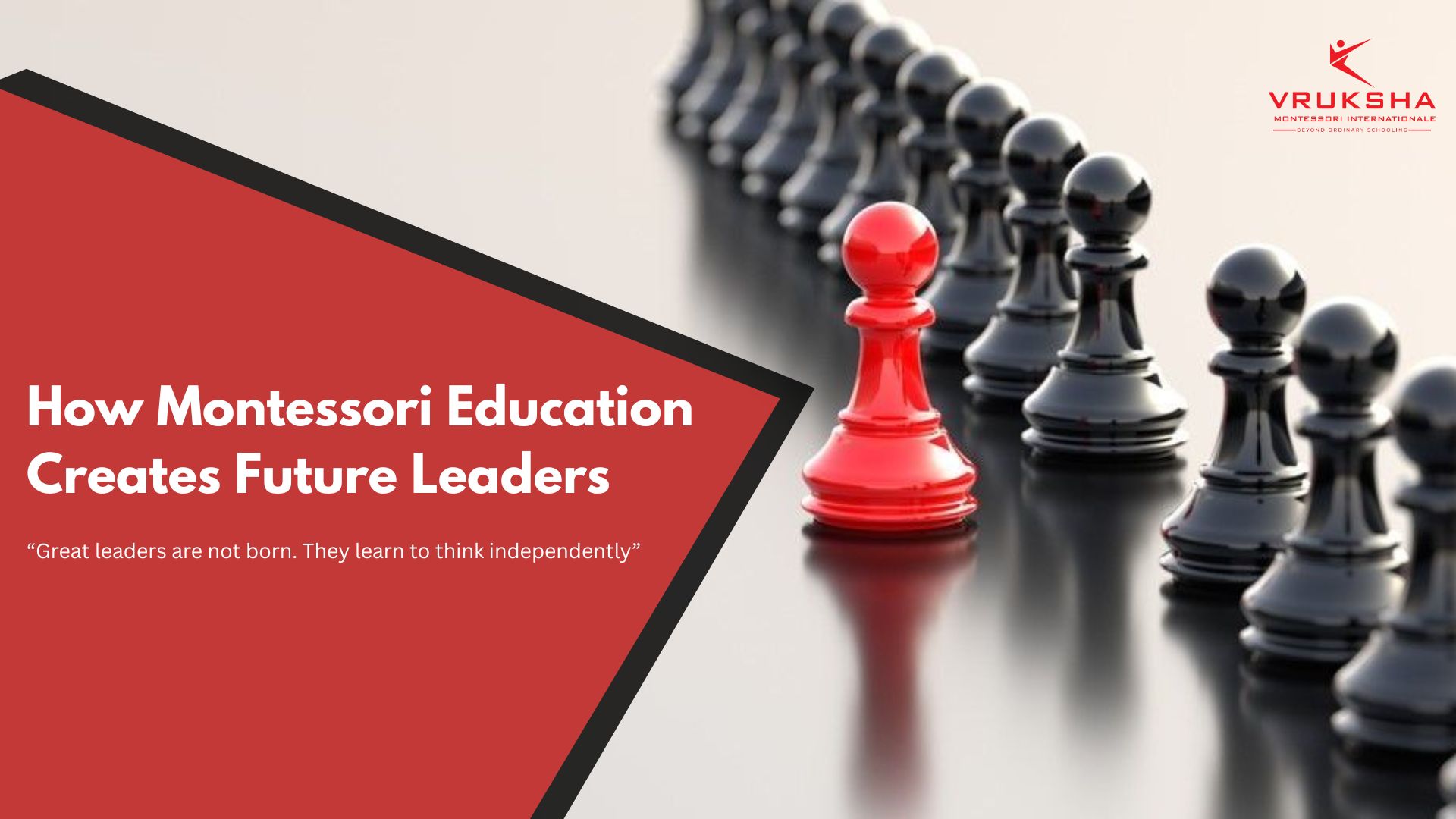
How Montessori Education Creates Future Leaders
In today’s world, success is no longer defined only by marks, ranks, or memorization. The future belongs to children who can think independently, communicate confidently, solve problems calmly, and adapt to changing environments. These are the qualities that define true leadership.
This is why many modern parents are beginning to rethink traditional education systems. They are asking an important question:
“Will my child only become academically successful, or will they become capable of handling real life confidently?”
Montessori education was designed to answer that question.
Unlike conventional systems that often depend heavily on pressure, comparison, and passive learning, Montessori education focuses on building independent, emotionally secure, self-driven children. It helps children develop the mindset and life skills needed to become future leaders, not just good test-takers.
At Vruksha Montessori School, leadership is not taught through speeches or competitions alone. It is developed naturally through daily responsibility, independent learning, emotional confidence, and respectful guidance.
Leadership Begins with Independent Thinking
One of the biggest differences in Montessori education is that children are encouraged to think independently from an early age.
In many traditional classrooms, children are trained to wait for instructions.
“Sit quietly.”
“Write exactly this.”
“Memorize this answer.”
Over time, children may become dependent on constant supervision and approval.
Montessori classrooms work differently.
Children are encouraged to:
ask questions,
make choices,
solve problems,
and think through situations independently.
This does not make children disobedient. It makes them capable.
Future leaders are not people who simply follow instructions. They are people who can think clearly, make decisions responsibly, and adapt confidently. Montessori education helps children develop these qualities naturally.
Confidence Without Fear
Many children today struggle with fear:
fear of mistakes,
fear of failure,
fear of judgment,
and fear of speaking openly.
When education becomes pressure-driven, children may begin to associate learning with stress instead of curiosity.
Montessori education creates emotionally safe learning environments where children are respected as individuals.
At Vruksha, children are not constantly compared with others. They are guided based on their own pace, strengths, and development. This helps children become emotionally secure and confident in expressing themselves.
Leadership grows when children feel safe enough to:
share ideas,
communicate openly,
try new things,
and learn from mistakes without fear.
Confident children are more likely to become confident leaders in the future.
Responsibility Creates Leadership
Leadership is deeply connected to responsibility.
A child who learns to manage small responsibilities early often grows into an adult who can handle larger responsibilities confidently.
Montessori education encourages children to take ownership of:
their learning,
their belongings,
their routines,
and their actions.
Inside Montessori classrooms, children actively participate in the learning process instead of passively receiving information.
Simple habits such as:
organizing materials,
completing tasks independently,
caring for classroom spaces,
and managing time responsibly
help build self-discipline and accountability.
At Vruksha, children are gradually guided toward becoming self-driven learners rather than children who work only under pressure.
This is one of the strongest foundations of future leadership.
Communication Skills Matter More Than Ever
The future will belong to people who can communicate ideas clearly and confidently.
Many academically strong students still struggle with:
public speaking,
expressing thoughts,
teamwork,
or interacting confidently with others.
Montessori education gives children regular opportunities to communicate naturally.
Mixed-age classrooms encourage:
conversation,
peer learning,
respectful interaction,
and collaborative problem-solving.
Children learn how to:
listen,
express ideas clearly,
respect others,
and communicate confidently with both adults and peers.
These are real-world leadership skills that cannot be developed through memorization alone.
Emotional Intelligence is the Real Superpower
Modern leadership is not only about intelligence. It is also about emotional balance.
Children who cannot manage emotions often struggle with:
pressure,
criticism,
relationships,
and adaptability later in life.
Montessori education supports emotional development alongside academics.
At Vruksha, calm discipline replaces fear-based control. Children are guided with patience, structure, and respect instead of shouting or punishment.
This helps children develop:
emotional regulation,
self-awareness,
empathy,
and internal discipline.
Emotionally secure children are more likely to become calm decision-makers, responsible team members, and thoughtful leaders in the future.
Learning Beyond Marks
Marks are important, but marks alone cannot define a child’s future capability.
A child may score highly in exams yet still struggle with:
confidence,
independent thinking,
communication,
adaptability,
or decision-making.
Montessori education focuses on strong conceptual understanding instead of rote memorization.
Children learn:
why concepts work,
how to apply knowledge,
and how to continue learning independently.
This creates long-term intellectual confidence.
At Vruksha, the goal is not simply to prepare children for exams. The goal is to prepare children for life beyond instruction.
Because the future will reward people who can continue learning, adapting, and solving problems independently.
Why Parents are Choosing Montessori Education Today
Many parents are beginning to realize that traditional success models are changing.
Today’s world requires children who are:
adaptable,
emotionally strong,
creative,
responsible,
and independent.
Parents are no longer looking only for schools that produce marks. They are searching for schools that help children become capable human beings.
That is why Montessori education is gaining the trust of families who want more meaningful learning experiences for their children.
At Vruksha Montessori School, education is designed not around fear or pressure, but around understanding, independence, and emotional growth.
Final Thoughts
Future leaders are not created through fear, comparison, or constant pressure.
They are created when children are:
emotionally secure,
intellectually respected,
encouraged to think independently,
and trusted with responsibility.
Montessori education helps children develop these qualities naturally from an early age.
The goal is not to create “perfect” children.
The goal is to create children who can:
think clearly,
communicate confidently,
adapt responsibly,
and continue learning throughout life.
Because true leadership begins with independence.
And that is exactly the kind of future Vruksha is building for every child.