
Why Comparing Children Does More Harm Than Motivation
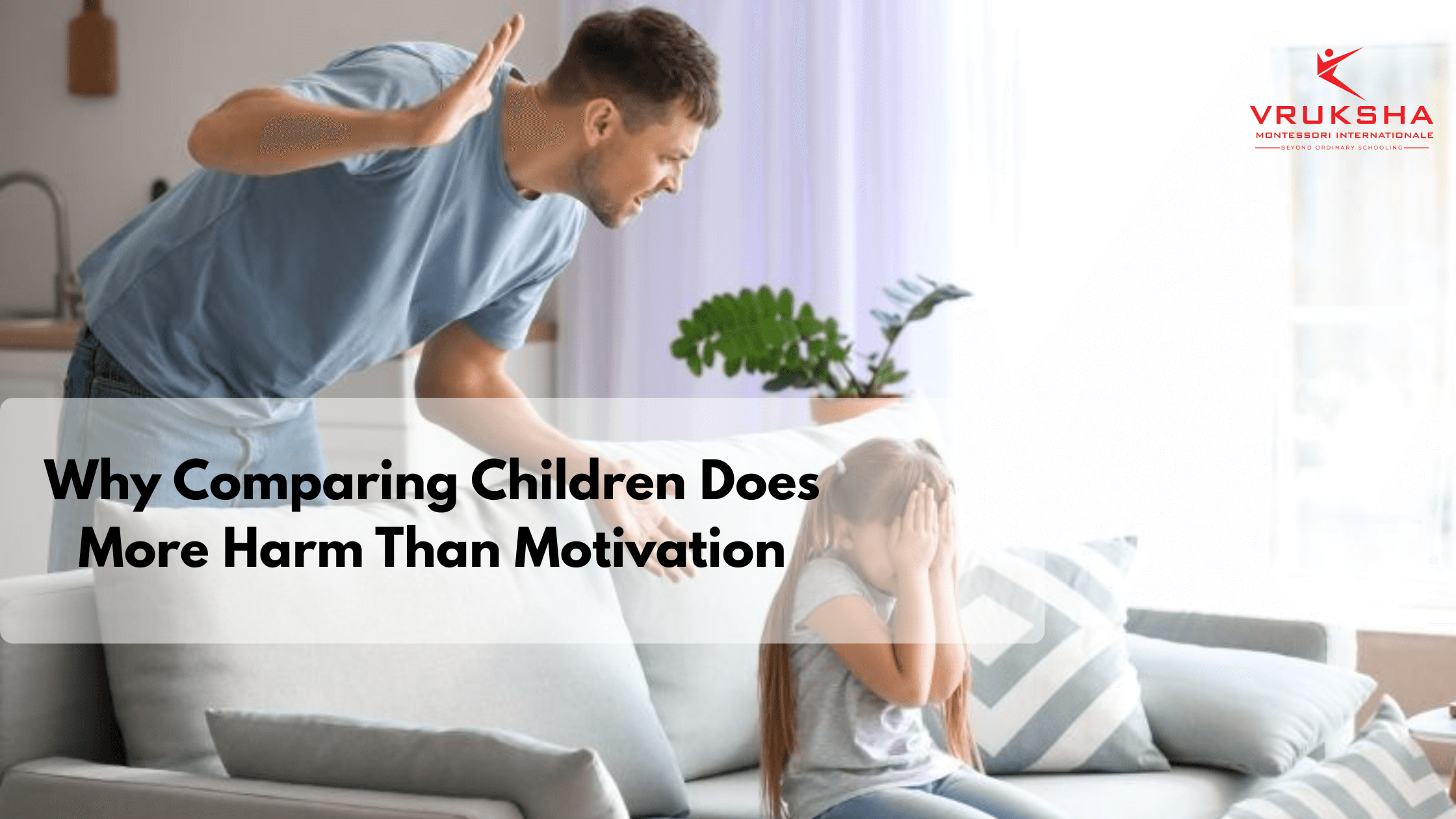
Comparison is often misunderstood as motivation.
“Well, if they see someone doing better, they’ll try harder.”
“If others can do it, why not my child?”
“A little pressure is good, right?”
These thoughts are common. They come from care, concern, and the desire to see children succeed. But what we see every day quietly and consistently is something very different.
Comparison does not motivate most children.
It confuses them, weakens confidence, and slowly disconnects them from learning itself.
Children Don’t Experience Comparison the Way Adults Do
Adults compare outcomes.
Children compare themselves.
When a child is compared to another child, they don’t hear:
“You can improve.”
They hear:
“I am not enough.”
Young children are still forming their sense of identity. They don’t yet have the emotional distance to separate what they did from who they are. So when comparison enters the picture, it doesn’t push them forward—it pulls them inward.
They stop asking:
What can I learn?
And start asking:
Am I good enough?
Why am I slower?
What’s wrong with me?
Comparison Creates Fear, Not Growth
When children grow up in a comparison-heavy environment, learning quietly changes shape.
They become afraid of making mistakes
They avoid trying new or difficult things
They choose “safe” answers over curious ones
They measure success by approval, not understanding
Over time, children learn an unspoken rule:
“It’s safer not to try than to try and be seen as less.”
This is not a motivation problem.
This is an emotional safety problem.
Every Child Develops Differently and That’s Not a Flaw
Children do not grow in straight lines.
Some speak early and read later.
Some move confidently but take time with language.
Some observe quietly before participating fully.
Comparison ignores this reality. It assumes development is linear, uniform, and predictable when it is none of those things.
When we compare children, we replace curiosity with timelines.
We stop asking:
“What does this child need right now?”
And start asking:
“Why isn’t this child like that one?”
Short-Term Results, Long-Term Cost
Yes, comparison may sometimes produce short-term compliance.
A child may:
Memorize faster
Complete work quicker
Perform better for a while
But beneath the surface, something important is happening.
The child learns that:
Their worth is conditional
Their value depends on performance
Learning is something to survive, not enjoy
As they grow older, this often shows up as:
Anxiety around exams
Fear of failure
Low self-trust
Burnout even in “high-performing” children
Motivation built on comparison is fragile.
Confidence built on self-trust lasts.
What Children Actually Need to Grow
Children thrive when they feel:
Seen without being judged
Safe to make mistakes
Trusted to grow at their own pace
Supported rather than measured
When children are not compared, something powerful happens.
They:
Take risks without fear
Ask questions freely
Learn deeply instead of quickly
Develop intrinsic motivation
They begin to learn for understanding, not for validation.
Encouragement Is Not the Same as Comparison
Encouragement sounds like
“I see how much effort you put into this.”
“You’re figuring this out in your own way.”
“Mistakes help us learn.”
Comparison sounds like
“See how fast they finished?”
“Why can’t you do it like them?”
“Others your age already know this.”
One builds inner confidence.
The other builds silent pressure.
What Happens When We Stop Comparing
When comparison is removed, children don’t become lazy.
They become secure.
Secure children:
Are more willing to try
Recover faster from mistakes
Develop resilience naturally
Build confidence from within
They don’t need to be pushed constantly because their motivation comes from curiosity, not fear.
A Final Thought for Parents
Every child is already on a journey.
Comparison pulls them off their own path and places them on someone else’s.
Real growth doesn’t come from being “better than” others.
It comes from becoming more comfortable with oneself.
When we stop asking children to compete,
We give them space to become who they are meant to be.
And that quietly, steadily, is where true confidence begins.
If you’re looking for a learning environment that protects confidence before chasing performance, Vruksha invites you to explore whether our approach aligns with your child’s journey.